🧠 Knowledge Management System (KMS)
A centralized engineering Knowledge Management System (KMS) built using Wiki.js to support onboarding, product documentation, QA processes, collaboration, and secure knowledge sharing across engineering teams.
Overview
Throughout my QA leadership journey, I designed, implemented, and administered internal Knowledge Management Systems (KMS) that became the single source of truth for engineering teams.
Rather than allowing critical knowledge to become scattered across emails, chat messages, spreadsheets, and individual documents, I centralized engineering documentation into a structured, searchable platform built with Wiki.js.
These systems supported Quality Assurance, Product Management, Business Analysis, Engineering, and Operations teams by making critical information easy to discover, maintain, and share.
The result was faster onboarding, improved collaboration, standardized processes, higher documentation quality, and long-term knowledge retention across the organization.
Why We Built It
As engineering teams grow, valuable knowledge can easily become scattered across emails, chats, shared drives, and individual team members.
The Knowledge Management System solved this problem by providing one central location where employees could find accurate, up-to-date documentation whenever they needed it.
Instead of repeatedly asking the same questions, team members could quickly search the knowledge base and find standardized documentation.
This approach promoted self-service learning, reduced dependency on tribal knowledge, improved process consistency, and significantly accelerated employee onboarding.
Challenges Solved
The Knowledge Management System addressed several common engineering challenges:
- Documentation scattered across multiple locations
- Inconsistent onboarding experiences
- Knowledge loss when team members changed roles
- Repeated support questions
- Outdated documentation
- Difficulty locating engineering information
Knowledge Architecture
The Knowledge Management System supported documentation across multiple areas.
👥 Team Onboarding
- QA Onboarding
- Employee Onboarding
- Department Onboarding
- Team Processes
📦 Product Knowledge
- Product Onboarding
- Product Documentation
- Feature Documentation
- Business Rules
- User Workflows
🧪 Quality Assurance
- Test Plans
- Test Cases
- Standard Operating Procedures (SOPs)
- Test Execution Workflows
- Bug Reporting Standards
- Release Procedures
- UAT Documentation
- Test Summary Reports
⚙ Engineering
- Tool Installation Guides
- Environment Setup
- Development Workflows
- Configuration Documentation
- Internal Engineering Standards
📚 Organizational Knowledge
- Internal Documentation
- Best Practices
- Frequently Asked Questions (FAQs)
- Lessons Learned
- Team Standards
- Process Documentation
Administration & Governance
Beyond creating documentation, I was responsible for administering the entire Knowledge Management System.
Responsibilities included:
- Designing the documentation structure
- Creating page hierarchies
- Organizing navigation
- Managing documentation categories
- Configuring user roles
- Implementing role-based access control (RBAC)
- Whitelisting approved employees
- Managing user permissions
- Maintaining documentation quality
- Reviewing and updating documentation
- Supporting internal users
- Creating documentation templates
- Maintaining documentation versioning
Security & Access Control
Because the platform contained confidential internal documentation, access was carefully controlled.
As the Knowledge Management System administrator, I managed:
- User account creation
- Role assignments
- Access permissions
- Department-specific visibility
- Documentation ownership
- Secure access for authorized employees only
- Audit and permission reviews
- Access lifecycle management
This ensured that only approved members of the organization could access internal engineering and product documentation.
Real-World Experience
Internal Knowledge Platforms
Designed and maintained Wiki.js knowledge bases for multiple engineering teams supporting:
Oasis Management Company
I have designed and managed internal Knowledge Management Systems across multiple organizations.
The Knowledge Management System supported:
- QA Onboarding
- QA Documentation
- Testing Workflows
- Internal Engineering Documentation
- Team Knowledge Sharing
ByteWorks Technology Solutions
The Knowledge Management System supported:
- Employee Onboarding
- Product Onboarding
- Product Documentation
- QA Documentation
- Tool Setup Guides
- Engineering Processes
- Internal Knowledge Sharing
- Role-Based Access Management
Behind the Scenes
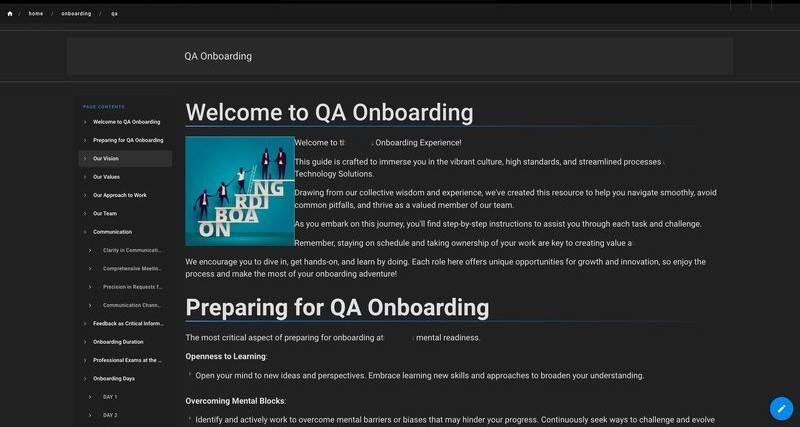
The screenshot below shows one of the KnowledgeThe screenshot below highlights one of the Knowledge Management initiatives I shared publicly on LinkedIn, showcasing how structured onboarding can improve engineering consistency and knowledge sharing.
Rather than relying on scattered documents or informal handovers, we built a structured onboarding system that helped new team members understand our tools, expectations, engineering processes, and organizational standards from day one.
This initiative improved consistency across the engineering team while making onboarding a smoother and more efficient experience.
Read the full LinkedIn article
Engineering Impact
Implementing the Knowledge Management System helped teams:
- Established a single source of truth for engineering knowledge
- Reduced onboarding time
- Standardized engineering processes
- Improved documentation quality
- Accelerated knowledge transfer
- Reduced repeated support requests
- Improved collaboration across departments
- Preserved institutional knowledge
- Increased engineering productivity
Technologies Used
Platform
- Wiki.js
- PostgreSQL
Documentation
- Markdown
- Technical Writing
Administration
- Documentation Architecture
- Knowledge Management
- Role-Based Access Control (RBAC)
Skills Demonstrated
Documentation
- Technical Documentation
- Documentation Architecture
- Standard Operating Procedures
Leadership
- QA Leadership
- Team Onboarding
- Engineering Collaboration
Knowledge Management
- Knowledge Management
- Internal Knowledge Sharing
- Process Improvement
- Role-Based Access Control (RBAC)
Information Architecture
The knowledge base was organized around a structured hierarchy to ensure documentation remained easy to discover and maintain.
Key design principles included:
- Logical page hierarchy
- Consistent navigation
- Standardized page templates
- Clear ownership
- Searchability
- Category-based organization
Key Takeaway
A Knowledge Management System is more than just documentation.
It is an investment in the long-term success of an engineering organization.
By making information easy to discover, maintain, and share, teams spend less time searching for answers and more time building high-quality software.
The result is faster onboarding, improved collaboration, better documentation quality, and a stronger engineering culture.
"The best engineering teams don't just build great software, they build systems that help people succeed."