🎭 Playwright Automation Framework
A modern end-to-end automation framework built with Playwright, focusing on cross-browser testing, maintainable architecture, and scalable test automation.
Overview
As I expanded my automation expertise beyond Cypress, I began exploring Playwright to better understand modern browser automation and cross-browser testing.
Rather than simply learning a new automation tool, I focused on understanding the engineering principles behind building reliable, maintainable, and scalable test frameworks.
This project reflects that journey by applying clean architecture, reusable components, and modern software engineering practices to create automation that remains easy to extend as applications evolve.
Framework Highlights
Architecture
The framework is built around modern automation engineering principles, including:
- Page Object Model (POM)
- Reusable Page Classes
- Test Fixtures
- Locator Strategies
- TypeScript
- Cross-browser Testing
- Screenshots & Traces
- HTML Reporting
- Modular Project Structure
Technologies Used
Core
- Playwright
- TypeScript
- Node.js
Testing
- Playwright Test Runner
Reporting & Debugging
- HTML Reports
- Trace Viewer
- Screenshots
- Video Recording
Development
- Visual Studio Code
Framework Architecture
The project follows a modular architecture designed for scalability and maintainability.
Typical components include:
- Page Objects
- Test Files
- Fixtures
- Utilities
- Configuration
- Test Data
- Reports
Project Structure
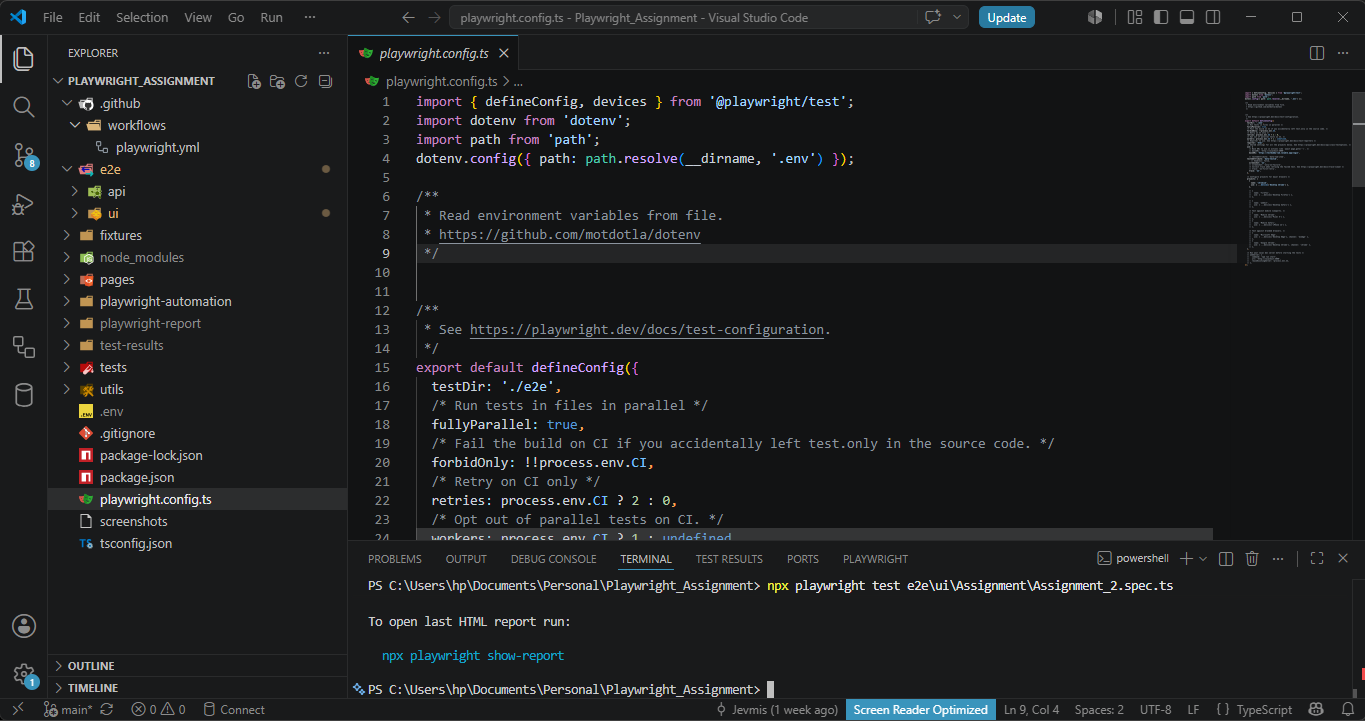
Applying the Page Object Model
One of the most valuable lessons while learning Playwright was understanding the importance of the Page Object Model (POM).
At first, creating separate page classes seemed unnecessary.
Why create another file when all the interactions could live inside a single test?
The answer became clear as projects grew.
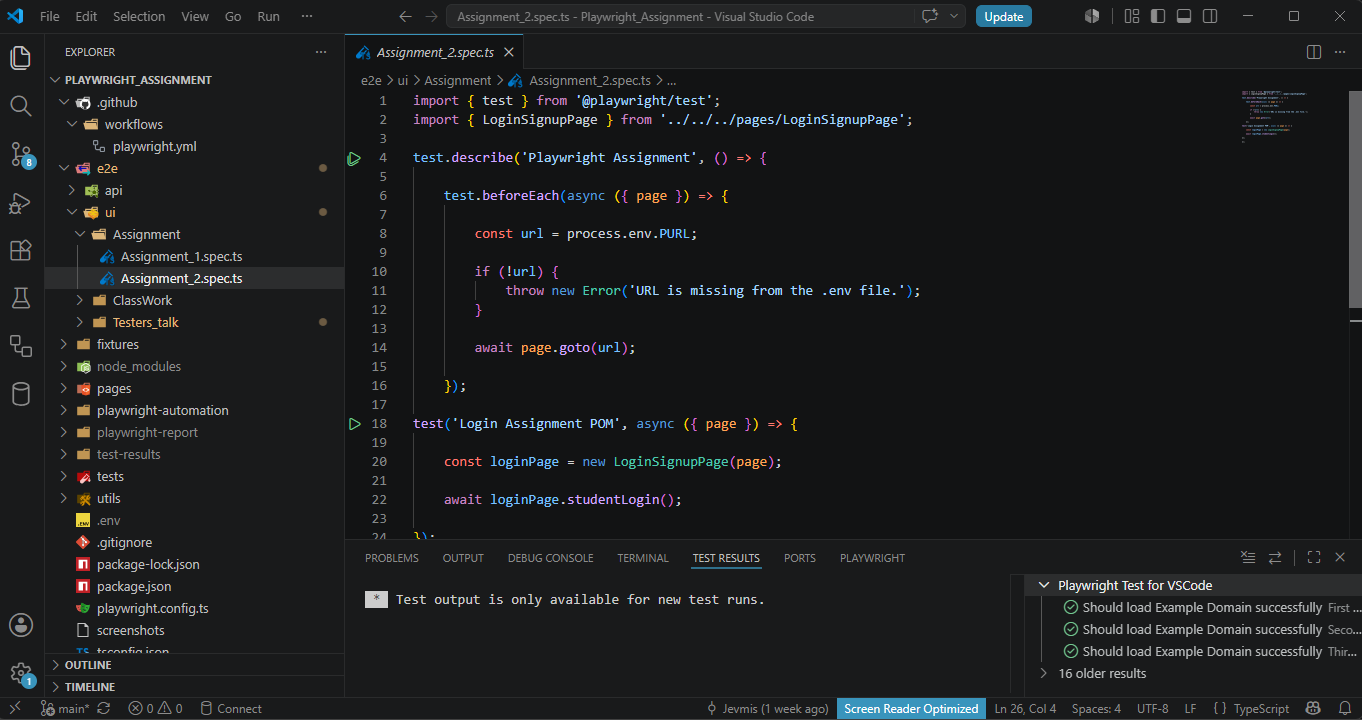
Instead of scattering selectors across multiple test files, user interactions are encapsulated into reusable page methods that can be shared throughout the framework.
For example, rather than repeatedly writing:
await page.getByLabel('Username').fill(username);

await page.getByLabel('Password').fill(password);

await page.getByRole('button', { name: 'Submit' }).click();
the test simply becomes:
This improves readability, reduces duplication, and makes UI changes much easier to maintain.
Page Object Example
Read the full engineering article
Locator Strategies
Playwright provides several powerful locator strategies, allowing tests to closely mimic real user interactions.
Examples include:
- getByRole()
- getByLabel()
- getByPlaceholder()
- getByText()
- CSS Selectors
- XPath
Using semantic locators improves test reliability and resilience against UI changes.
Cross-Browser Testing
One of Playwright's greatest strengths is its native support for multiple browser engines.
The framework supports testing across:
- Chromium
- Firefox
- WebKit
This enables early detection of browser-specific issues without requiring additional tooling.
Running the same tests across Chromium, Firefox, and WebKit helps identify browser-specific issues early, improving confidence before release.
Engineering Impact
This framework was designed to:
- Improve test maintainability through reusable page objects
- Reduce duplicated automation code
- Simplify future UI updates
- Enable reliable cross-browser validation
- Support scalable test development as applications grow
Reporting & Debugging
Playwright includes powerful debugging capabilities that simplify investigation when tests fail.
Features include:
- HTML Reports
- Trace Viewer
- Screenshots
- Video Recording
- Step-by-step Execution
- Network Inspection
These capabilities provide detailed visibility into every test execution, making failures easier to reproduce, diagnose, and resolve.
Lessons Learned
Building this framework reinforced one important engineering principle:
Automation is not just about executing tests—it is about designing software.
Good automation frameworks apply the same engineering principles used in application development:
- Separation of concerns
- Reusability
- Readability
- Maintainability
- Scalability
Understanding these concepts has helped me build automation that is easier to extend and maintain over time.
Skills Demonstrated
Automation Engineering
- Playwright
- TypeScript
- Automation Framework Design
- Page Object Model
Testing
- Cross-browser Testing
- Locator Strategies
- Test Automation
Engineering
- HTML Reports
- Software Engineering Principles
"The true value of an automation framework isn't measured by how many tests it runs, but by how easily it adapts as the product evolves."