🔌 API Testing & Validation
Designing and executing reliable API testing strategies to ensure backend services are secure, performant, and function correctly before reaching end users.
Project Overview
Project Overview
Modern applications rely heavily on APIs to power web, mobile, and third-party integrations. Throughout my QA career, I have designed and executed API testing strategies that validate backend functionality independently of the user interface.
By testing APIs early in the development lifecycle, I help identify defects before they impact frontend functionality, improving release confidence, reducing debugging effort, and supporting faster software delivery.
My approach combines functional validation, backend verification, security checks, and reusable automation to ensure APIs are reliable, secure, and production-ready.
Testing Objectives
- Validate API functionality
- Verify request and response structures
- Ensure proper authentication and authorization
- Detect backend defects before UI testing
- Improve regression confidence
- Support continuous delivery pipelines
Technologies
| Tool | Purpose |
|---|---|
| Postman | Manual & Automated API Testing |
| Swagger / OpenAPI | API Documentation |
| SQL | Backend Data Validation |
| REST APIs | Functional Testing |
| JSON | Request & Response Validation |
| JavaScript | Postman Test Scripts |
| Git | Version Control |
API Testing Coverage
Authentication
- Login
- Logout
- JWT Tokens
- Bearer Tokens
- API Keys
- Session Validation
Functional Validation
- CRUD Operations
- Resource Creation
- Resource Updates
- Resource Deletion
- Search APIs
- Filtering
- Sorting
- Pagination
Response Validation
- Status Codes
- Response Time
- Response Body
- JSON Schema
- Error Messages
- Required Fields
- Optional Fields
- Response Headers
- Content-Type Validation
Database Validation
- SQL Database Verification
- Data Integrity
- Record Creation
- Record Updates
- Transaction Validation
Negative Testing
- Invalid Requests
- Missing Parameters
- Invalid Authentication
- Invalid Payloads
- Unsupported HTTP Methods
- Boundary Conditions
Sample Validation Checklist
✅ Authentication & Authorization
✅ Status Code Validation
✅ Response Schema Validation
✅ Business Rule Validation
✅ SQL Database Verification
✅ Error Handling
✅ Response Time Validation
✅ Data Integrity Checks
Example Workflow
Client Request
        │
        ▼
REST API
        │
        ▼
Authentication
        │
        ▼
Business Logic
        │
        ▼
Database Validation
        │
        ▼
Response Verification
Engineering Practices
My API testing approach incorporates engineering practices that improve consistency, maintainability, and scalability, including:
- Early API validation before UI testing
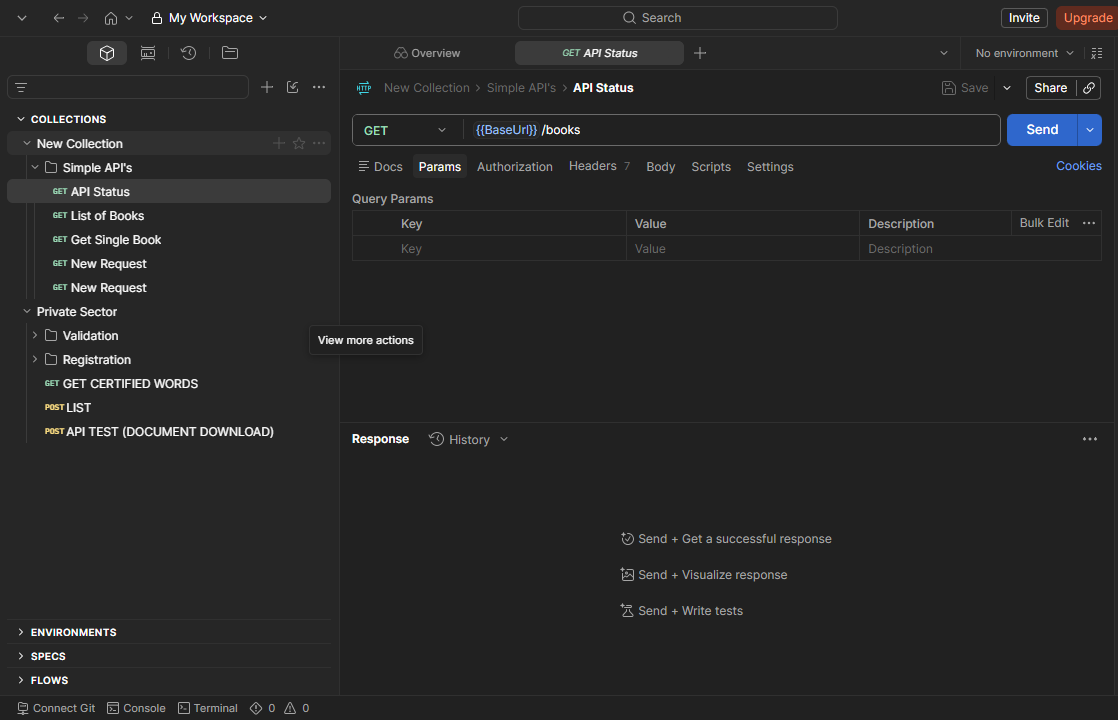
- Reusable Postman Collections
- Environment & Collection Variables
- Automated Assertions
- Data-driven Testing
- Negative & Boundary Testing
- SQL Database Verification
- Regression Testing
- Version-controlled API Collections
Typical API Testing Workflow
My typical API testing process includes:
- Review API documentation
- Understand business requirements
- Validate authentication mechanisms
- Test functional and negative scenarios
- Verify backend data using SQL
- Validate response structures and business rules
- Document defects with supporting evidence
- Re-test after fixes and execute regression testing
Business Impact
API testing delivers value beyond defect detection by:
- Detecting backend issues before UI development
- Reducing debugging effort
- Improving release confidence
- Accelerating regression testing
- Protecting data integrity
- Supporting automation initiatives
- Enabling faster software delivery
Skills Demonstrated
API Testing
- REST API Testing
- Postman
- Swagger / OpenAPI
- Authentication Testing
Backend Validation
- SQL Validation
- Backend Verification
- JSON Parsing
Quality Engineering
- Regression Testing
- Business Rule Validation
- Fintech API Testing
Sample API Collection
Lessons Learned
Working with APIs has reinforced the importance of validating backend services independently of the user interface.
Well-designed API testing enables earlier defect detection, simplifies debugging, improves automation reliability, and increases confidence in every software release.
By validating business rules, authentication, data integrity, and response behavior before frontend integration, engineering teams can deliver more reliable software with fewer production issues.
"The user interface is only as reliable as the APIs behind it. Great API testing builds confidence before users ever interact with the application."