🐞 Bug Reporting & Defect Management
Delivering clear, actionable, and reproducible defect reports that enable development teams to resolve issues efficiently and improve overall software quality.
Overview
Identifying defects is only one part of Quality Assurance. Equally important is communicating those defects clearly enough for engineering teams to understand, reproduce, prioritize, and resolve them efficiently.
Throughout my career, I've maintained structured defect management practices that improve collaboration between QA, developers, product owners, and stakeholders. My approach emphasizes clarity, reproducibility, and business impact, ensuring every defect report contributes to faster resolution and higher software quality.
Defect Management Workflow
Requirement
      │
      ▼
Test Execution
      │
      ▼
Issue Identified
      │
      ▼
Investigation
      │
      ▼
Bug Report Creation
      │
      ▼
Developer Review
      │
      ▼
Bug Fix
      │
      ▼
Retesting
      │
      ▼
Regression Testing
      │
      ▼
Closure
Bug Report Template
Every defect report is designed to provide developers with all the information required to reproduce and resolve an issue efficiently.
Basic Information
- Summary
- Description
- Environment
- Preconditions
Validation
- Steps to Reproduce
- Expected Result
- Actual Result
Classification
- Severity
- Priority
Supporting Evidence
- Screenshots
- Screen Recordings
- Browser Console Logs
- Network Logs
- SQL Query Results
- API Request & Response Payloads
- Browser & Device Information
Severity Levels
| Severity | Description |
|---|---|
| Critical | System unusable or complete functionality failure |
| High | Major functionality affected with no acceptable workaround |
| Medium | Functionality affected but workaround exists |
| Low | Minor issue with minimal business impact |
| Cosmetic | UI or visual issue with no functional impact |
Priority Levels
| Priority | Description |
|---|---|
| P1 | Immediate fix required |
| P2 | High business importance |
| P3 | Normal development cycle |
| P4 | Future improvement |
Supporting Evidence
To improve reproducibility, I attach evidence whenever possible:
- Screenshots
- Screen recordings
- Browser console logs
- Network logs
- SQL validation results
- API responses
- Device information
Tools Used
| Tool | Purpose |
|---|---|
| Jira | Defect Tracking |
| Google Sheets | Defect Reporting & Metrics |
| Browser DevTools | Root Cause Investigation |
| SQL | Backend Validation |
| Postman | API Verification |
| OBS / Screen Recording | Video Evidence |
Defect Lifecycle
Sample Bug Reports
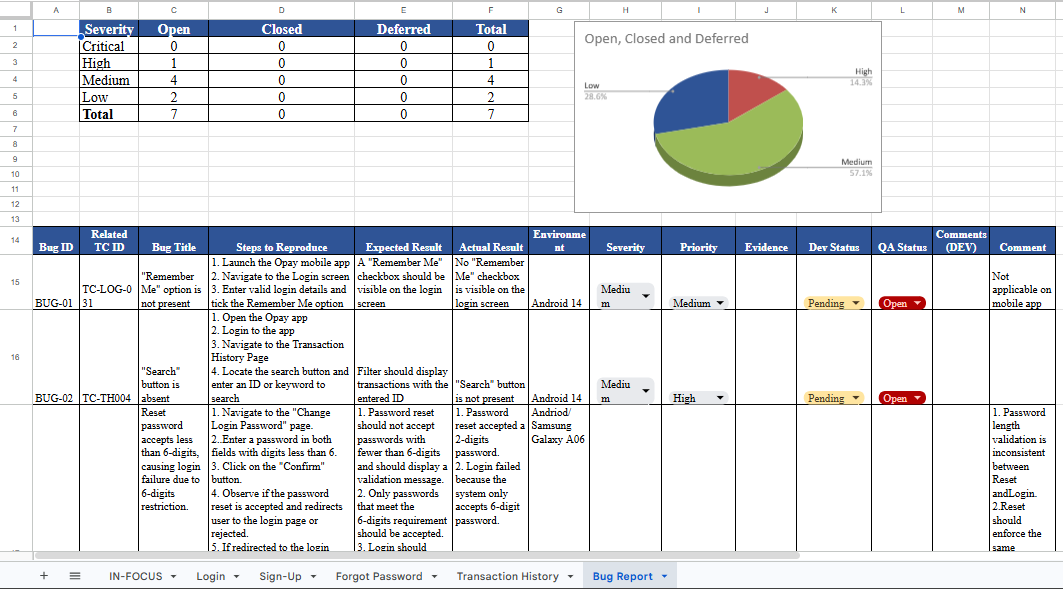
Examples included within my portfolio demonstrate different reporting styles used across projects, including:
- Jira Defect
- Google Sheets Defect Log
- Markdown Bug Report
-
PDF Defect Report
-
Recommended examples:
- Jira Bug
- Google Sheets Defect Log
- Markdown Bug Report
- PDF Bug Report
- Validate issues before reporting.
- Link defects to business requirements where applicable.
Defect Reporting Principles
Every defect report I create follows four core principles:
- Clarity over complexity
- Reproducibility
- Business impact awareness
- Actionable recommendations
Common Defect Categories
Typical defects I've investigated include:
- Functional Issues
- Validation Errors
- UI/UX Defects
- API Failures
- Database Inconsistencies
- Performance Issues
- Security Findings
- Browser Compatibility Issues
- Regression Defects
Best Practices
- Write concise and descriptive summaries.
- Provide clear reproduction steps.
- Include expected and actual results.
- Assign appropriate severity and priority.
- Attach supporting evidence.
- Verify fixes before closing defects.
- Perform regression testing after resolution.
Business Impact
A structured defect management process helps engineering teams:
- Reduce communication gaps
- Accelerate issue resolution
- Improve developer productivity
- Increase release confidence
- Improve software quality
- Maintain end-to-end traceability
- Support data-driven release decisions
Skills Demonstrated
Quality Engineering
- Defect Management
- Regression Testing
- Root Cause Analysis
Investigation
- SQL Validation
- API Verification
Collaboration
- Jira
- Google Sheets
- QA Documentation
- Stakeholder Communication
Lessons Learned
Effective bug reporting goes beyond documenting defects—it enables collaboration.
Clear, reproducible, and well-prioritized defect reports reduce unnecessary back-and-forth discussions, shorten resolution times, and help engineering teams deliver reliable software with greater confidence.
A well-written bug report should enable another engineer to understand the issue without requiring additional clarification.
"A bug report isn't just a record of a defect, it is a communication tool that helps engineering teams solve problems efficiently."