⚡ Performance Engineering
Designing and executing performance tests to evaluate application scalability, stability, reliability, and responsiveness under varying workloads.
Overview
Performance testing plays a critical role in ensuring applications remain responsive, stable, and scalable under both expected and peak workloads.
Using Apache JMeter, I have designed and executed performance tests to evaluate application behavior, identify bottlenecks, validate performance requirements, and provide actionable recommendations that improve software reliability before production deployment.
My approach combines structured test planning, realistic workload simulation, detailed analysis, and data-driven reporting to support informed engineering decisions.
Performance Testing Objectives
- Measure application response times
- Validate system stability under load
- Identify performance bottlenecks
- Evaluate scalability
- Support release readiness
- Improve user experience
Technologies
| Tool | Purpose |
|---|---|
| Apache JMeter | Load & Performance Testing |
| CSV Data Sets | Test Data |
| HTTP Request Samplers | API/Web Testing |
| Listeners | Result Analysis |
| Assertions | Validation |
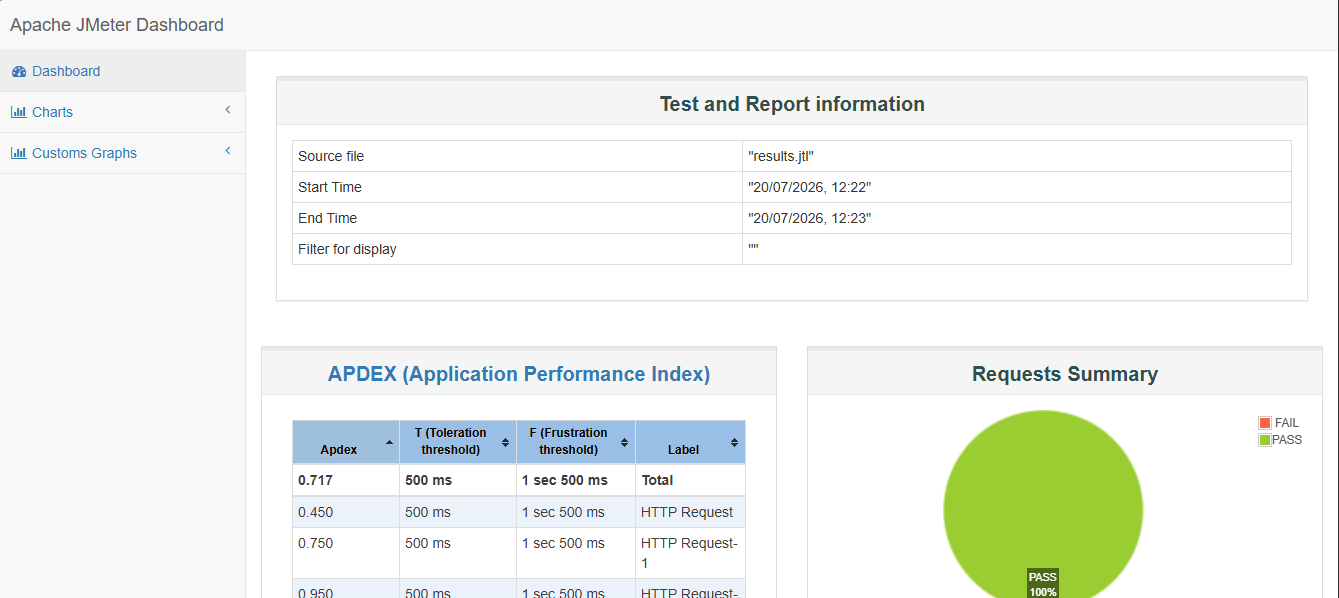
| HTML Reports | Performance Reporting |
Engineering Approach
Every performance assessment follows a structured methodology:
- Understand performance requirements
- Define realistic workloads
- Build reusable JMeter test plans
- Execute baseline testing
- Increase load incrementally
- Monitor application behavior
- Analyze bottlenecks
- Provide optimization recommendations
- Re-test after improvements
Types of Performance Testing
Baseline Testing
Establish expected system performance under normal operating conditions before conducting more intensive testing.
Load Testing
Validate application performance under expected user load.
Stress Testing
Determine system breaking points under extreme traffic.
Spike Testing
Evaluate how the application reacts to sudden traffic increases.
Endurance Testing
Measure stability during prolonged execution.
Scalability Testing
Assess how the application scales as workload increases.
Performance Metrics
The following metrics are monitored during execution:
Response Metrics
- Average Response Time
- Minimum Response Time
- Maximum Response Time
- 95th Percentile Response Time
Throughput Metrics
- Throughput
- Transactions Per Second
- Requests Per Second
Infrastructure Metrics
- CPU Utilization
- Memory Utilization
- Network Usage
Reliability Metrics
- Error Rate
- Failed Requests
Performance Testing Workflow
Performance Requirements
          │
          ▼
Test Planning
          │
          ▼
Test Script Development
          │
          ▼
Load Execution
          │
          ▼
Results Collection
          │
          ▼
Analysis
          │
          ▼
Recommendations
JMeter Components Used
- Thread Groups
- HTTP Request Samplers
- CSV Data Sets
- Timers
- Assertions
- Listeners
- Variables
- Controllers
Best Practices
- Establish a performance baseline
- Simulate realistic user behavior
- Increase concurrency gradually
- Validate functional correctness under load
- Monitor infrastructure metrics
- Analyze bottlenecks before optimization
- Re-test after performance improvements
Sample Reports
Examples available within this portfolio include:
- JMeter Test Plan
- HTML Performance Dashboard
- Response Time Analysis
- Throughput Report
-
Performance Summary
-
Engineering Insights
Performance testing is most valuable when it provides actionable insights rather than raw numbers.
My focus is on identifying:
- Performance bottlenecks
- Resource constraints
- Scalability limitations
- Slow endpoints
- Opportunities for optimization
The goal is to help engineering teams make informed decisions before software reaches production.
Business Impact
Performance engineering helps organizations:
- Prevent production outages
- Improve application reliability
- Enhance user experience
- Support capacity planning
- Identify scalability limitations
- Reduce performance-related incidents
- Increase release confidence
Skills Demonstrated
Performance Testing
- Apache JMeter
- Load Testing
- Stress Testing
- Spike Testing
- Endurance Testing
Analysis
- Bottleneck Identification
- Capacity Planning
- Performance Analysis
- Performance Reporting
Lessons Learned
Performance engineering is more than executing load tests, it is about understanding how systems behave under varying workloads.
Effective performance testing combines realistic workload simulation, careful analysis, and actionable recommendations that help engineering teams improve scalability, stability, and user experience before software reaches production.
"Performance isn't measured when everything goes right, it's revealed when systems are pushed to their limits."