📑 QA Documentation
Comprehensive Quality Assurance documentation designed to standardize testing processes, improve collaboration, and support high-quality software delivery.
Overview
Quality Assurance extends far beyond executing test cases.
Throughout my career, I've developed structured documentation that helps teams plan, execute, monitor, and continuously improve software quality.
From test strategies and release documentation to onboarding guides and engineering knowledge bases, these artifacts establish consistent processes, improve collaboration, and support reliable software delivery.
Rather than treating documentation as an afterthought, I consider it a core engineering asset that enables teams to scale effectively.
Technologies & Platforms
Documentation developed using:
- MkDocs Material
- Wiki.js
- Markdown
- Microsoft Word
- Google Docs
- Microsoft Excel
- Jira
Documentation Philosophy
Good documentation should be:
- Clear
- Practical
- Reusable
- Easy to maintain
- Easy to understand
- Accessible to both technical and non-technical stakeholders
Good documentation serves as a shared source of truth, enabling engineering teams to work consistently, onboard faster, and deliver software with greater confidence.
Quality Planning
- Test Strategies
- Test Plans
- Test Cases
Process Documentation
- QA Workflows
- Standard Operating Procedures (SOPs)
- QA Onboarding Guides
Release Documentation
- Release Checklists
- UAT Plans
- Release Documentation
Knowledge Management
- Engineering Knowledge Bases
- Requirement Validation Documents
- Bug Reporting Guidelines
Sample Documentation
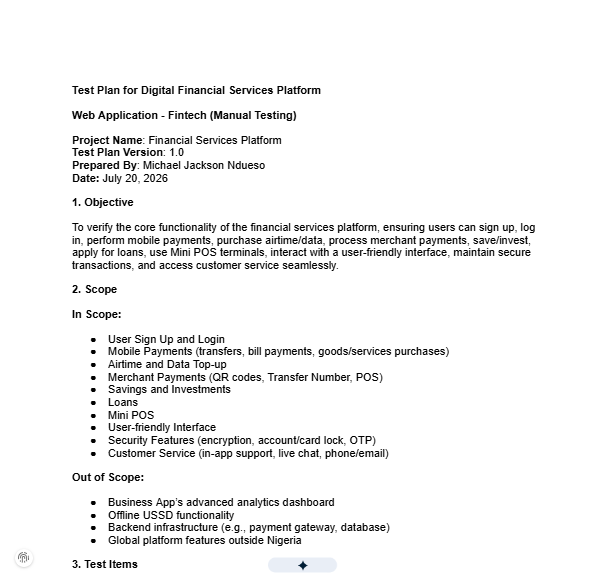
Documentation Workflow
Every document follows a structured lifecycle to ensure consistency.
Requirements
        │
        ▼
Test Strategy
        │
        ▼
Test Planning
        │
        ▼
Test Design
        │
        ▼
Test Execution
        │
        ▼
Bug Reporting
        │
        ▼
Regression Testing
        │
        ▼
Release Validation
        │
        ▼
Knowledge Capture
Examples of Documentation Produced
📋 Test Strategy
Defines:
- Testing scope
- Objectives
- Risks
- Test approach
- Entry criteria
- Exit criteria
📑 Test Plans
Includes:
- Features under test
- Testing schedule
- Resource allocation
- Deliverables
- Risks
- Dependencies
🧪 Test Cases
Structured test cases containing:
- Preconditions
- Test steps
- Expected results
- Test data
- Postconditions
🐞 Bug Reporting Standards
Every defect report includes:
- Summary
- Environment
- Severity
- Priority
- Reproduction steps
- Expected result
- Actual result
- Screenshots
- Logs
- Recommendations
🚀 Release Documentation
Prepared release documents covering:
- Smoke Testing
- Regression Results
- Known Issues
- Risk Assessment
- Deployment Validation
- UAT Sign-off
- Release Readiness
📚 Knowledge Base
Created centralized engineering documentation containing:
- QA Standards
- Team Procedures
- Testing Guidelines
- Reusable Templates
- Troubleshooting Guides
- Onboarding Resources
Benefits Delivered
Well-structured QA documentation has helped teams:
- Standardized QA processes
- Improved testing consistency
- Reduced onboarding time
- Improved collaboration across cross-functional teams
- Reduced knowledge loss
- Increased release confidence
- Simplified long-term maintenance
Engineering Impact
These documentation systems helped engineering teams by:
- Establishing consistent QA standards
- Improving communication across teams
- Accelerating onboarding for new engineers
- Supporting repeatable testing processes
- Increasing release readiness through structured validation
- Preserving institutional knowledge
Skills Demonstrated
Quality Engineering
- Test Planning
- Test Strategy
- Requirement Analysis
- User Acceptance Testing
- Defect Management
Documentation
- QA Documentation
- Technical Writing
- Release Management
Process Improvement
- Software Quality Processes
- Process Improvement
"Great documentation doesn't create extra work, it enables teams to deliver quality more consistently."